Research

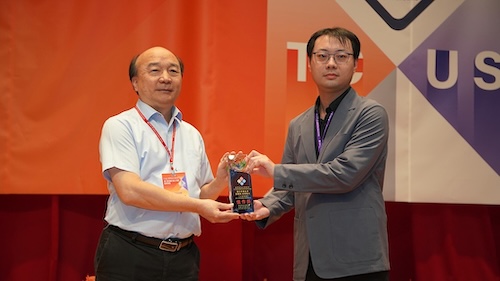
Dr Lan Receives Meritorious Research Award at TCUS Innovation Competition

Dr Lan was recognised with a Meritorious Research Award in this year’s Young Scholars Innovation Competition organised by the Taiwan Comprehensive University System (臺灣綜合大學系統). His research highlights a cross-domain biomimetic propulsion concept that leverages AI techniques to enhance energy efficiency in both aerial and aquatic environments. By drawing on natural movement strategies and translating them into engineered designs, this work demonstrates how bio-inspired thinking can open new possibilities for multifunctional propulsion, a direction that aligned strongly with the competition’s emphasis on innovative academic contributions.

New Study on Odour Boundaries Published in Physica D

Dr Lan’s latest study, Flow-induced variations in odour boundary formation, explores how odours spread through moving air, an essential process in animal navigation and robotic sensing. Through flow simulations, the research introduces the concept of an ‘odour boundary’ and analyses how it responds to changes in flow speed and diffusion conditions. The team found that while diffusion has limited effect, higher airflow speeds narrow and stabilise the odour boundary. These findings deepen our understanding of biological tracking behaviours and may aid the design of robots capable of locating odour sources in complex environments.

For more information please refer to https://doi.org/10.1016/j.physd.2025.134827.

Innovative Approach to Flapping Flight Analysis Published in Physica D

Dr Lan and Dr Lai’s latest study, ‘Accelerating Flapping Flight Analysis: Reducing CFD Dependency with a Hybrid Decision Tree Approach for Swift Velocity Predictions’, has been published in Physica D: Nonlinear Phenomena. The research introduces a novel framework combining signal decomposition and decision tree algorithms, reducing computational time by up to 75% while maintaining high accuracy. Validated with damselfly data, this approach accelerates flapping flight analysis and supports the efficient design of micro air vehicles (MAVs), offering a scalable solution for future aerodynamic research.

For more information please refer to https://doi.org/10.1016/j.physd.2025.134618.

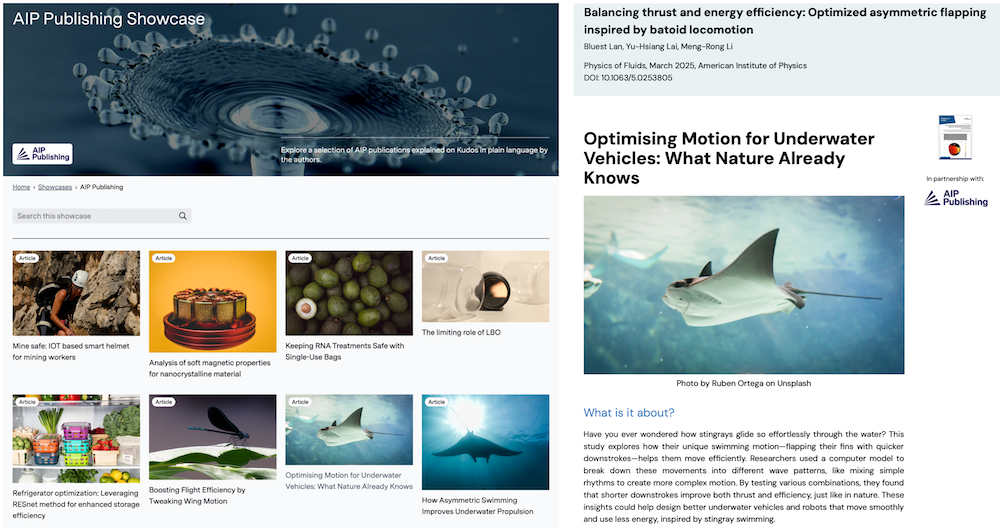
Innovative Insights Featured on AIP Publishing Showcase

Dr Lan and his research team have been recognised by the American Institute of Physics (AIP), with their latest study selected as a feature article on Kudos’ Showcase platform. The research, titled ‘Balancing Thrust and Energy Efficiency: Optimised Asymmetric Flapping Inspired by Batoid Locomotion’, explores how the unique swimming motion of stingrays can inspire more efficient designs for underwater vehicles.

By using advanced computer simulations, the team discovered that shorter, quicker downstrokes—similar to how stingrays naturally move—enhance thrust while reducing energy consumption. These findings could lead to the development of underwater vehicles and robots that move more efficiently, with potential applications in marine exploration and environmental monitoring.

Currently, Dr Lan and his team have three articles featured on the AIP Publishing Showcase homepage, highlighting their contributions to nature-inspired scientific research.

Published in Physics of Fluids: Biomimetic Propulsion Study

Dr Lan, Dr Lai and their team have published a study in Physics of Fluids exploring how stingray-like asymmetric flapping enhances underwater propulsion. Using a NACA 0012 hydrofoil at a Reynolds number of 10,000 and NSGA-II optimisation, they identified six optimal motion patterns with brief downstrokes. Their findings reveal how harmonic tuning influences vortex dynamics, closely resembling natural swimming. This research provides key insights for designing efficient biomimetic aquatic robots, advancing underwater propulsion technology.

For more information please refer to https://doi.org/10.1063/5.0253805.

Breakthrough in Manta-like Swimming Efficiency

A big congratulations to Dr Lai’s team and Dr Lan on the successful publication of their groundbreaking research in Physics of Fluids! Their study explores how manta-like swimming dynamics, specifically asymmetric motion parameters, can greatly enhance the efficiency of underwater unmanned vehicles. By investigating the effects of varying angles of attack and stroke duration, the research provides key insights into maximising thrust and propulsion efficiency. This work not only advances our understanding of aquatic biomechanics but also paves the way for innovative designs in biomimetic underwater technologies. Well done to the team on this impressive achievement!

For more information please refer to https://doi.org/10.1063/5.0229833.

Research Paper Published in 'Ocean Engineering': A Leap Forward

Heartfelt congratulations to Dr Lai’s team and Dr Lan on their seminal publication in ‘Ocean Engineering’. Their paper, ‘Strouhal number impact on propulsion efficiency in fully-active oscillating foils: Unpacking frequency, amplitude, and velocity relationships’, is not just a leap forward in marine technology but also holds immense potential for transforming oscillating foils technology across diverse realms, from the depths of the ocean to the intricacies of flapping flight.

For more information please refer to https://doi.org/10.1016/j.oceaneng.2024.116686.

New Journal Paper on Drones

Great news! The paper titled ‘A Neural Network Approach to Estimate Transient Aerodynamic Properties of a Flapping Wing System’ by Lan et al. has been published in the journal Drones. Congratulations!

For more information please refer to https://doi.org/10.3390/drones6080210.

Research Reported by AIP

The research conducted in the paper ‘Optimal thrust efficiency for a tandem wing in forward flight using varied hindwing kinematics of a damselfly’ was reported by AIP Scilight, congratulations.

For more information please refer to https://aip.scitation.org/doi/full/10.1063/10.0012500.

Paper Accepted by Physics of Fluids

The paper ‘Optimal thrust efficiency for a tandem wing in forward flight using varied hindwing kinematics of a damselfly’ was accepted by the journal Physics of Fluids, congratulations.

For more information please refer to https://doi.org/10.1063/5.0093208.